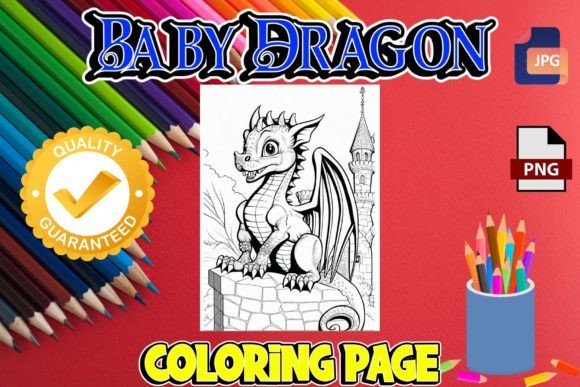
Unlocking Creativity: The Practical Power of a Baby Dragon Coloring Book Page for Kids
In the bustling world of self-publishing and digital content creation, a single, well-crafted asset like a Baby Dragon Coloring Book Page for Kids can be the cornerstone of a successful project. This isn't just a whimsical illustration; it's a versatile, high-resolution file designed for professional use, particularly in creating interiors for Amazon Kindle Direct Publishing (KDP). For creators, entrepreneurs, and educators looking to build a high-content book business, understanding the true value and proper application of such a page is crucial. Many dive in with enthusiasm but overlook key details that can make or break their final product.
The Allure and Reality of Ready-Made Coloring Pages
At first glance, a Baby Dragon Coloring Book Page for Kids offers a charming, engaging subject perfect for young artists. Dragons captivate children's imaginations, making such pages highly appealing. For the adult buyer—whether a blogger creating free resources, a teacher designing classroom activities, or an entrepreneur assembling a coloring book for sale—it represents efficiency. The promise is clear: a tested, professionally formatted file (8.5" x 11", 300 DPI) in both JPG and PNG formats, ready to integrate into your own unique KDP interior. This eliminates the need for design skills or expensive software, allowing you to focus on compilation and marketing. However, the journey from downloading the file to publishing a successful book is where common missteps occur.
Overlooking the "Unique Interior" Imperative
A frequent misunderstanding is treating a single Baby Dragon Coloring Book Page for Kids as a complete solution. Amazon’s marketplace is saturated, and KDP requires originality for a book to stand out and avoid issues with content quality standards. Simply collecting a handful of similar pages from various sources and bundling them into a book often results in a disjointed, unprofessional interior. The layout, stylistic consistency, and flow from one page to another matter immensely to the end-user—the child coloring the book. A jarring shift in illustration style or complexity between pages can frustrate a young user and lead to poor reviews.
The better approach: Use the provided high-resolution file as a core template or a quality benchmark. Your goal should be to create a cohesive collection. This might mean sourcing or creating additional pages that match the same artistic style, line thickness, and thematic charm as your initial baby dragon page. Think about building a world around that dragon—adding companion characters, environments, and objects that maintain visual harmony. This creates a satisfying, professional book interior that feels intentionally designed, not haphazardly assembled.
Technical Specifications: More Than Just Numbers
The description lists ✅ 1 JPG file 300 dpi ✅ 1 PNG file 300 dpi ✅ Size 8.5″ x 11″ Inch. Beginners might assume that meeting these specs guarantees print-ready quality. However, 300 DPI (dots per inch) is a minimum standard for crisp printing. A common mistake is not verifying the actual resolution of the file upon receipt. Occasionally, files are upscaled from lower resolutions, which can result in blurry or pixelated lines when printed, even if the metadata says 300 DPI. Additionally, the difference between the JPG and PNG formats is overlooked. PNG files typically support transparency (useful for overlays or digital use), while JPGs are standard for print. Using the wrong format for your intended platform can affect the final presentation.
Practical advice: Before integrating any page into your KDP interior, open the files in a basic image viewer and zoom in to 100% or more. Examine the lines of the baby dragon illustration. Are they sharp and clean, or do they appear fuzzy? Check the file size; a true 300 DPI image at 8.5x11 inches should have a substantial file size (often several megabytes). For print interiors, use the JPG file. If you plan to offer the page as a standalone digital download on a blog or educational site, the PNG might be more versatile. This simple check saves you from the costly error of publishing a book with subpar image quality.
The High Content Book Business Model Pitfalls
Many enter the KDP space attracted by the "high content book business" model, where interiors are compiled from many pages. The Baby Dragon Coloring Book Page is marketed as "fully tested in the Amazon Kindle," which implies compatibility. However, a tested page doesn't guarantee a tested book. A critical error is neglecting KDP’s trim size and bleed settings. While the page is 8.5" x 11", corresponding to US Letter size, KDP offers multiple trim sizes. If you choose a different trim size without properly adjusting and centering your pages, the final printed book could have misaligned content or unwanted borders. Furthermore, cramming too many pages into a single book without considering pricing and page count thresholds can make your project unprofitable.
A constructive solution: Start small. Use the baby dragon page as the foundation for a short, focused coloring book—perhaps 10-15 pages. Ensure your KDP project settings match the file dimensions exactly. Use Amazon’s interior previewer tool meticulously before publishing. This allows you to validate layout, test the model with a minimal investment, and gather real feedback before scaling up to a true "high content" volume. It’s a more manageable and professional path than immediately attempting a 100-page book.
Beyond the Download: Maximizing Value for Your Audience
The ultimate goal is to provide value to your end audience: children and the adults purchasing for them. A mistake creators make is viewing the Baby Dragon Coloring Book Page for Kids solely as a commercial asset. They forget to consider the child’s experience. Is the dragon’s design appropriately complex for the target age group? Are the lines thick enough for small hands to color within? An illustration that is too intricate might discourage a young child, while one too simple might not engage an older one. This oversight affects customer satisfaction and repeat business.
How to avoid this: Think from the user’s perspective. If you’re a parent, educator, or have access to children, test the page! Print it out and give it to a child in your target age range. Observe their engagement and difficulty. Use this feedback to curate or create accompanying pages that offer a balanced progression of difficulty. In your book description on KDP, clearly state the recommended age range based on this testing. This builds trust and demonstrates that your book is thoughtfully crafted, not just a quick compilation.
Legal and Ethical Considerations Often Ignored
When purchasing a digital file for commercial use, its license is paramount. The assumption that "because I bought it, I can use it freely in my book" is a risky one. Some sellers grant full commercial rights, while others may have restrictions. Using a page without clear licensing can lead to copyright infringement issues, resulting in book removal or legal challenges. Another overlooked detail is the uniqueness of the design. While the baby dragon page itself may be original, if hundreds of other sellers use the exact same file in their books, your "unique interior" becomes commonplace, harming your market differentiation.
What to check before making a decision: Always verify the seller’s terms of use. Look for explicit statements regarding commercial use in KDP books. If it’s not stated, ask. Furthermore, consider modifying the page to add uniqueness. With graphic software, you could add subtle background elements, texture, or combine it with other original elements. This enhances the page’s originality while still leveraging the high-quality base artwork. It transforms a purchased asset into a truly custom component of your book interior.
Embarking on a project with a Baby Dragon Coloring Book Page for Kids holds fantastic potential. By moving beyond seeing it as a simple download and instead treating it as a foundational tool for professional creation, you can avoid the common pitfalls that hinder so many self-published projects. Attention to technical quality, cohesive book design, user experience, and commercial legality turns this single charming page into the heart of a successful, high-quality coloring book that stands out in the marketplace and delights its young audience.