The "No You're Right" T-Shirt: An Unexpected Catalyst for Workflow Integration
In the world of creative and business workflows, inspiration is often drawn from unexpected sources. The No You're Right T-Shirt is more than just a humorous garment; it is a graphic emblem that encapsulates a specific attitude—a blend of sarcastic acquiescence and collaborative mischief. For creators, entrepreneurs, and professionals managing print-on-demand (POD), publishing, or merchandising businesses, this piece of graphic content represents a versatile asset that can be strategically integrated into a broader production and marketing process.
Understanding the Asset: Beyond the Graphic
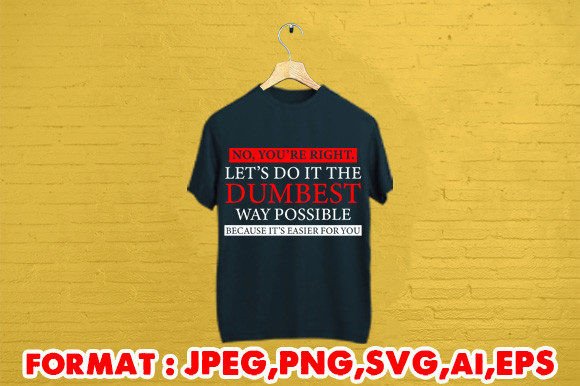
The core of the No You're Right T Shirt is a design concept that resonates on multiple levels. On one hand, it's a statement of ironic agreement, perfect for niche humor markets. On the other, as part of a product line that includes variants like "No You're Right Let's Do It The Dumbest Way Possible," it taps into a culture of self-aware, relatable humor. This makes it a potent asset for a creative business workflow, serving not as an endpoint, but as a flexible component within a larger system of content creation and product development.
This graphic fits into the planning phase of a project as a definable product idea. Before a single item is sold, the design exists in multiple high-quality file formats—JPEG, PNG, EPS, AI, and SVG. This preparation is crucial for workflow efficiency. Each format has a distinct role: PNG for transparent backgrounds on web stores, SVG and EPS for scalable, lossless quality in all-over-print applications, and AI for editable master files. Having these assets prepared and organized from the outset eliminates compatibility issues later and ensures consistency across a diverse product range.
Integration into a Multi-Channel Product Workflow
The true practical value of an asset like the No You're Right T Shirt design is revealed in its application across platforms and products. A modern POD or KDP business is not monolithic; it operates across multiple output channels. The design isn't confined to a standard t-shirt. The available file formats enable its seamless use on a spectrum of items, each representing a different branch of your workflow.
Core Product Line Expansion
Starting with apparel, the design can be applied to:
- Tank Tops, Crewneck Sweatshirts, and Long Sleeve T-Shirts for seasonal variations.
- Kids Hoodies and Onesies, expanding the target audience within the same brand theme.
- Baseball T-Shirts for a specific style niche.
This requires a workflow where the master design file is adapted—not recreated—for each product template. Using the scalable SVG or EPS files ensures the graphic maintains quality control when resized for a kids' item or a large sweatshirt print area.
Beyond Apparel: Diversifying Your Output
The workflow extends laterally into non-apparel products, which often share the same backend platforms or require similar file preparations:
- Phone Cases, Laptop Cases, and Magnets: These utilize the PNG or JPEG files with specific dimension checks.
- Wall Art, Notebooks, and Pillows: For these, the high-resolution JPEG is key, while the AI or EPS file allows for color adjustments to match different decor or material palettes.
- Tote Bags, Tapestries, and Pins: These items test the design's versatility and might require separations or simplifications, easily managed from the original AI file.
This diversification is a practical implementation strategy for risk mitigation and market testing. One design concept fuels multiple product experiments, streamlining the creative process and focusing effort on marketing rather than constant new design creation.
Workflow Coordination with Publishing and Digital Products
For entrepreneurs also operating in the KDP (Kindle Direct Publishing) space, a design like this can intersect with complementary projects. The mention of KDP Interior Coloring Books and Coloring Pages alongside the t-shirt files suggests a holistic content strategy. The humorous, graphic nature of the "No You're Right" concept could be adapted into themed coloring pages. Here, the workflow interaction is about asset repurposing.
The AI or EPS file becomes the starting point. Line work can be extracted or simplified to create coloring book pages. This creates a cohesive brand experience across different product categories—wearable apparel and interactive activity books—while maximizing the utility of a single creative idea. This approach speaks directly to efficiency and long-term asset use.
Practical Implementation Tips
To integrate such a graphic asset smoothly into your routine, consider these process-oriented steps:
- Centralized Asset Management: Store all file formats (JPEG, PNG, EPS, AI, SVG) in a clearly named project folder. This is fundamental for organization and quick retrieval when a new product opportunity arises.
- Template Preparation: For each primary product channel (e.g., specific POD platform for t-shirts, another for mugs), create base templates that already incorporate your brand's sizing or safety margins. Dropping the appropriate format file into these prepped templates drastically reduces production time.
- Batch Creation: When launching a design, use a batch workflow. Upload the PNG to your apparel listings, the high-res JPEG to wall art and notebook listings, and prepare the SVG for all-over-print items simultaneously. This parallel processing ensures consistent market launch timing.
- Quality Control Loops: Use the AI file as your master. Any feedback or observation from sales (e.g., "design looks small on hoodies") should lead you back to this editable source to make a universal adjustment, then re-export all derivative formats, maintaining consistency across all products.
Observing Market Fit and Iterative Use
The integration of such a design asset is not static. Its use before, during, and after a project cycle provides valuable data. Before a campaign, the design is a hypothesis about market humor. During the rollout, its performance on different products (e.g., does it sell better as a t-shirt or a phone case) informs resource allocation. After the initial launch, observations can lead to iterative development—perhaps creating spin-off designs or adapting the concept for new formats like pin designs or tapestries.
This cyclical process turns a single graphic into a durable tool within your business workflow. It interacts with platform analytics, customer feedback, and trend observations. The design's success on a crewneck sweatshirt might indicate its appeal in cooler climates, prompting a focused marketing effort in relevant regions or the development of additional winter apparel.
Long-Term Usability and Brand Building
A strong, relatable graphic like the No You're Right T Shirt design can become a minor brand pillar. Its long-term use is anchored in its file quality. The provision of high-quality, editable source files (AI and EPS) means the design is not a dead-end asset. It can be refreshed—colors changed for a seasonal collection, text slightly altered for a new context—without starting from scratch. This sustainability is a critical factor for professionals seeking to build a library of evergreen assets that support consistent quality and efficient operations over years.
Ultimately, the practical value lies not in the garment itself, but in the workflow fluency it enables. From the initial organization of multi-format files to the batch deployment across disparate products and the iterative refinement based on market data, this asset exemplifies how a well-prepared creative component can streamline execution, enhance consistency, and provide a flexible foundation for business growth in the creative commerce space.